
Coalition on Agricultural Greenhouse Gases

Who We Are
Coalition on Agricultural Greenhouse Gas (C-AGG)
The Coalition on Agricultural Greenhouse Gases (C-AGG) is a multi-stakeholder coalition fostering a fact-based discourse on the development and adoption of voluntary incentives to reduce GHG emissions from the agricultural sector. C-AGG participants and stakeholders include agricultural producers and producer groups, scientists, environmental NGO’s, carbon market developers, methodology experts, and investors, and other proponents of voluntary agricultural GHG mitigation opportunities and benefits.
How We Operate
C-AGG convenes diverse stakeholders to promote agreement on the development of effective and mutually beneficial opportunities to reduce GHG emissions from agriculture. Multiple policies and programs offer potentially effective options to incentivize farm-scale GHG mitigation while benefiting producers, including the following:
- Voluntary and compliance carbon markets with agricultural offset opportunities
- Ecosystem and environmental service markets
- Sustainable supply chain initiatives
- Conservation programs targeted to agricultural operations
C-AGG convenes stakeholder dialogues at three 2-day meetings per year to address the challenges facing the sector and our goals of incentivizing mutually beneficial outcomes. We hold intermittent workshops on issues requiring a more focused work effort, and when relevant, we offer webinars or briefings of interest to stakeholders. The C-AGG website is a resource intended to showcase C-AGG products and activities, including summaries and documents from past meetings, as well as related information from other sources.
C-AGG Challenges
Despite the critical and pivotal role the agricultural sector can play in climate change mitigation and adaptation, climate change policies and programs are largely directed at point-source emissions reductions activities and approaches. Agricultural and land use GHG mitigation opportunities pose a different set of challenges that require different approaches more appropriate to the sector. Diversity and change are inherent characteristics of agricultural systems. Agriculture depends on diverse biological processes and diverse managers operating in outdoor environments subject to constantly changing weather, climate, pests, input costs and availability, and multiple regulatory requirements. This complexity necessitates a flexible approach to support and incentivize innovative methods to achieve GHG emissions reductions and increased sequestration in a quantifiable manner. The C-AGG approach seeks constructive engagement of the agricultural sector and all stakeholders to help design, test, demonstrate, and adapt policies that can balance these complexities while creating opportunities and value for the agricultural sector while achieving demonstrable GHG emissions reductions at a meaningful scale.
Our Focus & Activities
In 2010 C-AGG issued a report that surveyed the landscape of GHG emissions reduction and carbon sequestration opportunities across the agricultural sector, and identified some critical challenges to mitigation programs and policies. The discussion and the policy landscape has matured and evolved considerably since that report, and C-AGG continues to probe and address the remaining challenges in this area, including:
- Identifying key research, data, or modeling needs to develop sound carbon and environmental market protocols and other incentive-based GHG mitigation opportunities for agriculture
- Characterizing, and contributing to the development of tools and calculators to enable agricultural producers to identify and compare GHG mitigation opportunities and potential benefits to their operations
- Sharing challenges, successes, and innovative solutions associated with GHG mitigation activities, including within carbon and environmental service markets, protocol and methodology development, sustainable supply chain initiatives, and conservation programs
- Engaging with appropriate federal and state agencies and other relevant organizations to share our knowledge, experiences, outcomes, and key recommendations in order to further develop voluntary GHG mitigation opportunities that provide value to the agricultural sector and society
Upcoming C-AGG Meeting Dates & Locations

The next C-AGG meeting will be held:
Tuesday & Wednesday, July 9 & 10, 2013 at the Westin Book Cadillac Hotel in Detroit, MI.
GHG Conservation Innovation Grants (CIG)
These demonstration projects have received competitive funding via the USDA’s Conservation Innovation Grant Program. C-AGG provides a convening opportunity that allows the participants to grapple with common challenges and seek solutions to achieve successful outcomes.
Getting Measurable Results
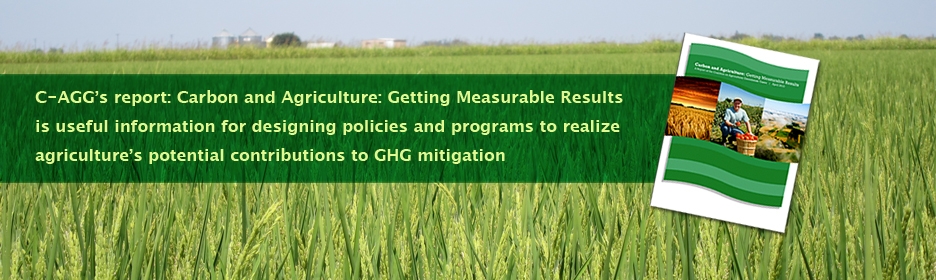
Carbon and Agriculture: Getting Measurable Results is a C-AGG Report providing information useful for designing policies and programs to realize agriculture’s potential contributions to Greenhouse Gas mitigation.
Thank you for your generous support!

The David and Lucile Packard Foundation's goals, through the use of grants, are to improve the lives of children, enable creative pursuit of science, advance reproductive health, and conserve and restore earth’s natural systems.
C-AGG submission on guideline development

Read the final C-AGG submission to the USDA Federal Register notice inviting comments on GHG guidelines development.
Many thanks to all of you who contributed and participated.
Suggested infrastructure and resource investments proposed by C-AGG to USDA.
C-AGG has been engaged in a dialogue with the US Department of Agriculture regarding current and future investments and strategic directions related to agricultural greenhouse gas mitigation opportunities.

©2012 Coalition on Agricultural Greenhouse Gases (C-AGG). All rights reserved.