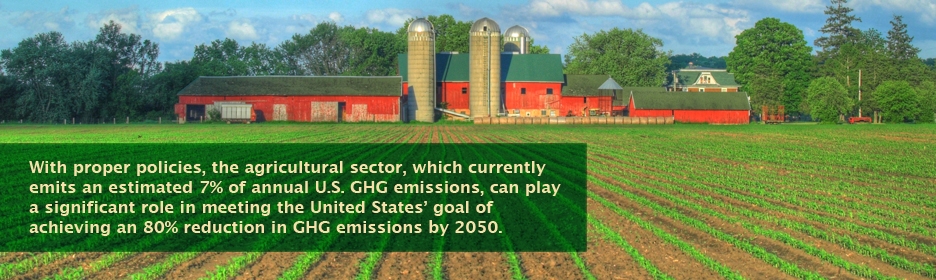
Agriculture can potentially play a major role in addressing the challenge of climate change. One important mechanism to unleash this potential is by providing financial incentives for farmers to ‘produce’ emission reductions or to sequester carbon. Any such system, however, must achieve the intended environmental outcomes and ‘work’ for both agricultural producers and potential investors. Land-based agricultural activities are gaining widespread attention as potential climate change mitigation tools in the context of land use and land-use change, but also from the perspective of sectoral mitigation and adaptation approaches.
With generous support from the David and Lucile Packard Foundation, three related initiatives focused on the policy, science, and quantification aspects of agricultural participation in carbon markets are underway. The three are described below.
C-AGG
The Coalition on Agricultural Greenhouse Gases (C-AGG) seeks to mitigate climate change and benefit farmers by advancing the development and adoption of science-based policies, methodologies, protocols, projects and programs for GHG emissions reductions and carbon sequestration within the agricultural sector. C-AGG members include agricultural producers, scientists, GHG quantification experts, carbon investors, policy experts, non-profit representatives, and GHG project developers. C-AGG is primarily a stakeholder forum for constructive engagement and dialogue, cross-pollination of initiatives and activities, and the development and positioning of supportive policy constructs that incentivize agricultural GHG mitigation activities.
C-AGG’s report, “Carbon and Agriculture: Getting Measurable Results”, was released in April, 2010, and represents contributions from participants in C-AGG, developed in consideration of the diversity of opinions within the Coalition. It is intended to serve as a catalyst for ongoing discussion, and will likely evolve over time as science, data and information improve and evolve, and as new drivers and supportive policy constructs to achieve agricultural mitigation of GHG are identified.
The Technical Working Group on Agricultural Greenhouse Gases (T-AGG) brings together technical expertise to assess and assemble the scientific and analytical foundation for developing high-quality agricultural protocols and programs. T-AGG hopes to expand the opportunities for agricultural practices that can mitigate climate change and benefit farmers. T-AGG involves academic experts in agriculture and related fields from across the United States in dialogue with federal agencies, carbon registries, agricultural producers, project developers, and policy experts.
T-AGG is producing a series of reports on key GHG mitigation activities for U.S. agriculture during 2010: a survey and comparison of a wide range of agricultural practices that can provide a road map for future protocol and policy development;, and updates on scientific complexities and implications for management for two promising agricultural activities – soil carbon management and nitrous oxide emissions reduction on cropland.
T-AGG Documents Available Online:
Greenhouse Gas Mitigation Potential of Agricultural Land Management in the United States: A Synthesis of the Literature
Assessing Greenhouse Gas Mitigation Opportunities and implementation strategies for Agricultural Land Management in the United States (DRAFT)
An Output-based Intensity Approach for Crediting Greenhouse Gas Mitigation in Agriculture: Explanation and Policy Implications
Comparison of Three Biogeochemical Process Models for Quantifying Greenhouse Gas Impacts of Agricultural Management (DRAFT)
The Market Mechanismsfor Agricultural Greenhouse Gases (M-AGG) is designed to bring particular focus to the carbon market infrastructure required for the agriculture sector to participate within emerging carbon policy and market frameworks. M-AGG is focused on identifying the current tools for quantifying greenhouse gas emission reductions and sequestration across a broad range of agricultural sectors. The M-AGG process will result in benchmarking a sub-set of these tools, namely quantification protocols, that fit a defined set of offset quality criteria common to most emerging carbon markets today.
The offset quality criteria include:
Principles adopted under C-AGG and other carbon market initiatives
Regulatory and programmatic guidance available from federal, regional and international climate change regimes and programs.
Structure, scientific approach, transparency and scalability criteria.
In June, 2010 M-AGG released a pair of reports on the availability of quantification tools across agricultural sectors and a benchmarking of available quantification protocols. These highlight opportunities for the on-going development of tools and protocols, and support voluntary or pilot (pre-compliance) projects to establish the path-to-market for carbon emission reductions and sequestration from within the agricultural sector.
M-AGG Documents Available Online:
Phase 1 Report: Agriculture Sector Greenhouse Gas Practices and Quantification Review
Phase 2 Report: Agriculture Sector Greenhouse Gas Quantification Protocol Benchmarking
Also, M-AGG Workshops were held in UC Davis, California, and Washington DC in June, 2010, with a webinar held in September, 2010. The presentations delivered at these workshops, and the videotaped content of the meetings are available at the Sustainable Food Lab URL listed above.